Lowcountry Real Estate, Mortgage, & Homeownership Resources

Welcome to the Rainbow Row Real Estate blog—practical, locally focused information for buying, selling, financing and owning a home along the South Carolina coast.

Here you’ll find straightforward explanations of the real estate and mortgage process, local market updates, neighborhood insights, homeowner resources and the occasional guide to Lowcountry life. Our goal is to help you make informed decisions without the pressure or confusing industry jargon.

Have a question or a topic you’d like us to cover? Reach out anytime. We’re always happy to have a local, no-pressure conversation.

Nov. 5, 2026

20 Lowcountry Restaurants Offering Thanksgiving Dinner or Takeout in 2026

20 Lowcountry Thanksgiving Dining & Takeout Options for 2026

Thanksgiving is Thursday, November 26, 2026. If you'd rather spend time with family than spend three days cooking and cleaning, we've rounded up 20 places across Charleston, Berkeley, Dorchester, Georgetown, and Horry counties where you can dine out or pick up a holiday meal.

The Quick Take

From Charleston buffets to Pawleys Island dinners and family meals to go, there are plenty of ways to let someone else handle Thanksgiving. Some restaurants serve on November 26, while others require advance ordering and pickup earlier in the week.

Important: Menus, prices, hours, and availability can change. Confirm directly with each restaurant before making plans.

Find Thanksgiving Dining Find Thanksgiving Takeout Community Meal

Sit Down & Let Them Cook

1. Oscar's of Summerville — Summerville, Dorchester County

Address: 207 W. 5th North Street, Summerville, SC
Thanksgiving: Buffet, 11 AM–4 PM
Price: $58 adults; $19 children ages 6–10; $9 children under 5. Reservations required.

Local Tip: Save room for the shrimp and grits and oyster cornbread stuffing.

View Oscar's Thanksgiving Menu

2. Church and Union — Charleston, Charleston County

Address: 32B North Market Street, Charleston, SC
Thanksgiving: Three-course dinner, 11 AM–9 PM
Price: $80 adults; $35 children 12 and under, before tax and gratuity.

Local Tip: Thanksgiving inside a former church makes for a memorable setting.

Visit Church and Union

3. Poogan's Porch — Charleston, Charleston County

Address: 72 Queen Street, Charleston, SC
Thanksgiving: Three-course Southern holiday dinner, 11 AM–9 PM
Price: $75 adults; $16 children's holiday menu.

Local Tip: A historic Charleston house is a great place for Thanksgiving when somebody else handles the dishes.

Visit Poogan's Porch

4. Sorelle — Charleston, Charleston County

Address: 88 Broad Street, Charleston, SC
Thanksgiving: Italian-American family-style dinner, noon–8 PM
Price: $125 adults; $50 children 12 and under, before tax and gratuity.

Local Tip: A little Italian influence might be exactly what your Thanksgiving tradition needs.

Visit Sorelle

5. Iron Rose — Charleston, Charleston County

Address: 115 Meeting Street, Charleston, SC
Thanksgiving: Buffet, 11 AM–7 PM
Price: $115 adults; $40 children under 13, plus 22% gratuity.

Local Tip: Buffet and carving stations mean you don't have to choose between turkey and everything else.

Visit Iron Rose

6. Local Eat Drink Celebrate — Pawleys Island, Georgetown County

Address: 10880 Ocean Highway, Pawleys Island, SC
Thanksgiving: Dining from 10 AM–2:30 PM, with regular menu and holiday specials.

Local Tip: She-crab soup followed by pumpkin or pecan pie sounds like a solid Thanksgiving plan.

Visit Local Eat Drink Celebrate

7. Litchfield Country Club — Pawleys Island, Georgetown County

Address: 619 Country Club Drive, Pawleys Island, SC
Thanksgiving: Dinner approximately noon–3 PM
Price: $44.95 adults; $22.95 children ages 4–12. Reservations required.

Local Tip: Turkey, prime rib, ham, and salmon make this a good choice for families with different tastes.

Visit Litchfield Country Club

8. Pawleys Tap House & Grill — Pawleys Island, Georgetown County

Address: 13089 Ocean Highway, Pawleys Island, SC
Thanksgiving: Dinner seatings from 11:30 AM–3 PM
Price: $32 adults; $15 children under 8.

Local Tip: A traditional Thanksgiving plate without the formal holiday production.

Visit Pawleys Tap House

9. Wahoo's Fish House & Bovine's — Murrells Inlet, Georgetown County

Address: 3993 Highway 17 Business, Murrells Inlet, SC
Thanksgiving: Buffet, 11 AM–5 PM
Price: $48.95 adults; $15.95 children ages 6–12; younger children free. A 20% gratuity applies.

Local Tip: Prime rib, turkey, fried shrimp, and a view of the MarshWalk. Not a bad Thanksgiving.

Visit Wahoo's Fish House

10. Wicked Tuna — Murrells Inlet, Georgetown County

Location: Murrells Inlet MarshWalk
Thanksgiving: Buffet, 11 AM–5 PM
Price: $48.99 adults; $25 children ages 6–10; younger children free.

Local Tip: Seafood and a raw bar alongside the turkey make this a very coastal Thanksgiving.

Visit Wicked Tuna

11. Amalfi at Hilton Myrtle Beach Resort — Myrtle Beach, Horry County

Location: Hilton Myrtle Beach Resort
Thanksgiving: Buffet, noon–6 PM
Price: $52 adults; $38 seniors; $25 children.

Local Tip: Look for shrimp and grits and braised short ribs alongside the traditional favorites.

Visit Hilton Myrtle Beach

12. Just Off Main at Avista Resort — North Myrtle Beach, Horry County

Location: Avista Resort, North Myrtle Beach
Thanksgiving: Seatings at 11 AM, 1 PM, and 3 PM
Price: $40.95 adults; $17.95 children ages 4–10, plus tax and gratuity.

Local Tip: You don't have to be staying at the resort to enjoy Thanksgiving dinner.

Visit Avista Resort

13. Tidewater Grill & Bistro — North Myrtle Beach, Horry County

Thanksgiving: Three-course dinner, 11 AM–7 PM
Price: $38.99 adults; $17.99 children 10 and under; ages 3 and under free. Reservations required.

Local Tip: Choose your starter and dessert while the Thanksgiving sides come with the meal.

View Tidewater's Thanksgiving Menu

Pick It Up & Take It Home

14. It's a Win-Win Restaurant & Catering — Moncks Corner, Berkeley County

Address: 417 Altman Street, Moncks Corner, SC
Thanksgiving: Dinner for 8–10 people, $350. Early-bird price $325 through November 13.
Order deadline: November 20
Pickup: November 25, 10 AM–noon.

Local Tip: A practical option for a bigger family gathering without spending all week cooking.

Visit It's a Win-Win

15. Mercantile & Mash — Charleston, Charleston County

Address: 701 East Bay Street, Charleston, SC
Thanksgiving: Dinner for 4–6 people, $265
Order deadline: November 21
Pickup: November 25 or Thanksgiving morning.

Local Tip: Their package includes turkey, sides, and pie. Add extra sides if your family takes mac and cheese seriously.

Visit Mercantile & Mash

16. Square Onion — Mount Pleasant, Charleston County

Address: 18 Resolute Lane, Mount Pleasant, SC
Thanksgiving: Holiday sides and dishes by preorder
Order deadline: November 21
Pickup: November 24 or 25.

Local Tip: Cook the turkey yourself and outsource the side dishes. Nobody needs to know.

Visit Square Onion

17. Cru Catering — North Charleston, Charleston County

Address: 1784 Harmon Street, North Charleston, SC
Thanksgiving: Meal kits and individual holiday items
Order deadline: November 18 at 2 PM
Pickup: November 25 at designated pickup locations.

Local Tip: Meal kits are designed around groups of four, making holiday planning easier.

Visit Cru Catering

18. Hamby Catering & Events — West Ashley, Charleston County

Address: 925 St. Andrews Boulevard, Charleston, SC
Thanksgiving: Meal packages starting at $239 for four, plus à la carte items
Order deadline: November 21 at 3 PM
Pickup: November 25.

Local Tip: Order the whole dinner or just the dishes you don't feel like making.

Visit Hamby Catering

19. Get Carried Away Southern Takeout — Pawleys Island & Georgetown, Georgetown County

Locations: 10126 Ocean Highway, Pawleys Island, and 109 Screven Street, Georgetown
Thanksgiving: Turkey, casseroles, sides, biscuits, and desserts
Ordering: Prepaid orders. Published information lists November 18 as the cutoff; confirm with the restaurant.
Pickup: November 23–25.

Local Tip: Don't overlook the cheese biscuits. Thanksgiving leftovers deserve good biscuits.

Visit Get Carried Away

20. Shoreline Café at Grande Shores — Myrtle Beach, Horry County

Location: Grande Shores, Myrtle Beach
Thanksgiving: Dine-in buffet or heat-and-serve family takeout
Price: $28.95 adults for dine-in buffet; $64.95 for family takeout
Takeout deadline: November 23.

Local Tip: A handy option for a Thanksgiving at the beach without cooking in a vacation rental.

Visit Grande Shores

One More Worth Sharing: A Community Thanksgiving Meal

Aunny's Country Kitchen — Georgetown

Address: 926 Front Street, Georgetown, SC
Thanksgiving: Free community meal, November 26, 11 AM–4 PM. Walk-ins welcome; donations accepted.

Thanksgiving is about community, and this is a wonderful local tradition to share.

Before You Make Thanksgiving Plans

All prices, hours, menus, and deadlines are subject to change. Restaurants may sell out or fill their reservation books early. Please contact each business directly to confirm its 2026 Thanksgiving offerings.

Whether you're dining out, ordering takeout, or cooking the whole thing yourself, we hope you have a wonderful Thanksgiving with the people who matter most.

Happy Thanksgiving from Rainbow Row Real Estate!

Love Exploring the Lowcountry?

We're always happy to help you discover more about the communities we call home.

Explore Rainbow Row Real Estate
Posted in Lowcountry Living
Nov. 2, 2026

Bubbles Up Guest Guide

WELCOME TO OUR HOME AWAY FROM HOME

Bubbles Up Guest Guide

Litchfield by the Sea • Pawleys Island • Murrells Inlet

Welcome! We’re Jared and Erin, and we’re so happy you’re staying at Bubbles Up. Whether your plans involve the beach, a lazy afternoon by the pool, or finding your next favorite restaurant, we hope this guide helps you settle in and enjoy your time here.

Save this page so you can find it throughout your stay. For your door code, Wi-Fi credentials, exact check-in time and reservation-specific instructions, please refer to your guest messages or contact us through your booking conversation.

The Quick Take

Keep your beach access pass handy, bring the supplied beach towels back to the condo, and return all six pool wristbands before departure. For an easy outing, pair dinner in Murrells Inlet with a stroll along the MarshWalk.

Updated November 2, 2026. Dining schedules, resort amenities and seasonal services can change. Confirm current hours before heading out.

Beach Days & Resort Time

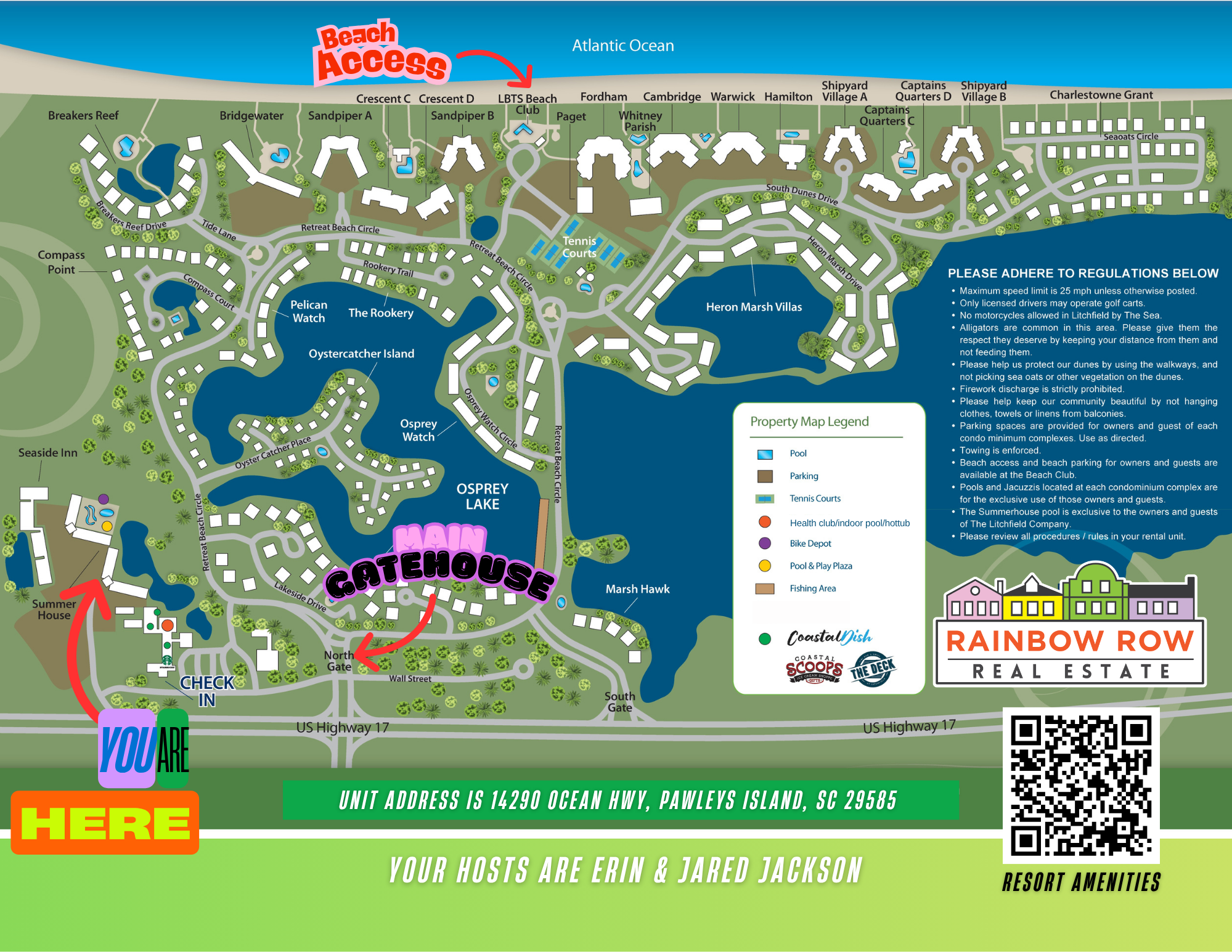
We love walking toward the beach and exploring the grounds. Your stay includes the resort access described in your reservation; keep your pass and any required wristbands with you.

  • Beach access: Follow the gate-pass instructions in your arrival message. Beach and resort access are subject to current community rules.
  • Summerhouse outdoor pool area: Enjoy the pool and lazy-river area when operating. Six pool wristbands are provided for Bubbles Up guests. Please return all six; the replacement charge is $50 per lost wristband.
  • Indoor pool, hot tub and fitness center: Access details are shared privately. If the code has changed, message us for help.
  • Tennis, pickleball, fishing and walking: Explore the recreation areas available with your stay. Check posted rules, reservations and any applicable fishing-license requirements.
  • Beach chairs, umbrellas and bikes: These are not supplied in the condo. Ask the resort about current rental options, pricing and seasonal availability.

Pool, fitness-center and rental schedules vary. Check posted hours or ask the front desk rather than relying on an older printed schedule.

Resort Amenities & Rentals

Make Yourself at Home

  • Wi-Fi and entry: Find your network, password and door instructions in your private guest information.
  • TV: Spectrum cable is on HDMI 3. You’re welcome to sign in to your own streaming services; remember to sign out before leaving.
  • Air conditioning: Please keep the setting at 70°F or above to help prevent the system from freezing. Message us if you need help with the programmed schedule.
  • Coffee and household supplies: Coffee is in the cabinets above the sink. Paper products, trash bags, dish soap and dishwasher detergent are provided. Use what you need during your stay and let us know if anything is running low.
  • Towels: Please use the supplied beach towels outdoors. White bath towels should stay inside because sunscreen can stain them. Bring every beach towel back to the condo.
  • Laundry: Shared paid washers and dryers are on the first floor in the east portion of Summerhouse. Machines are limited; follow the instructions posted in the laundry area.
  • Trash: Use the designated dumpsters at the end of the building or near the service building. Ask us if you need help locating them.

If anything isn’t working, please message us through your booking conversation so we can help while you’re here.

Where to Eat

Here are some favorites around Pawleys Island and Murrells Inlet. Use the restaurant buttons for current menus, reservations and hours.

On Site: Coastal Dish

Coastal Dish is in the courtyard across from the front desk and is a convenient breakfast option without leaving the resort.

Latest published schedule: The resort’s main listing currently shows breakfast daily from 6:00–10:30 a.m. and dinner closed for the season.

The official website also contains conflicting older hours. Please confirm with the front desk before an early breakfast or planning dinner, especially during the off-season.

Coastal Dish & Resort Dining

Pawleys Island Favorites

Frank’s & Frank’s Outback

A favorite for a date night or a special dinner. Plan ahead and check reservation availability.

10434 Ocean Highway, Pawleys Island

Frank’s Menu & Details

Moe’s Original BBQ

Our go-to suggestion for an easy meal after traveling. The smoked chicken is a favorite of ours.

12827 Ocean Highway, Pawleys Island

Moe’s Menu & Details

Habanero’s Mexican Restaurant

Our area pick when the vacation calls for Mexican food.

11151 Ocean Highway, Pawleys Island

Habanero’s Menu & Details

Murrells Inlet & the MarshWalk

Make an evening of it: choose a restaurant, then take a relaxed walk along the waterfront. Check each venue’s schedule for music and special events.

Wicked Tuna

Seafood, sushi and waterfront dining. Select the Murrells Inlet location when checking menus or making plans.

4123 US-17 Business, Murrells Inlet

Wicked Tuna Menu & Details

Neptune Bistro & Raw Bar

Another waterfront option with views of the inlet.

4139 US-17 Business, Murrells Inlet

Neptune Details

Judy Boone’s

Our pick for a Southern-style buffet and comfort food.

4664 US-17 Business, Murrells Inlet

Judy Boone’s Menu & Details

Dead Dog Saloon

A casual, family-friendly option on the MarshWalk serving breakfast, lunch and dinner. Check its live-music calendar when planning your evening.

4079 US-17 Business, Murrells Inlet

Dead Dog Saloon Menu & Details

Drunken Jack’s

A choice for a classic Murrells Inlet seafood meal and inlet views, right on the MarshWalk.

4031 US-17 Business, Murrells Inlet

Drunken Jack’s Menu & Details

Explore the MarshWalk

A Little Exploring Beyond the Resort

Brookgreen Gardens

Give yourself time to wander among gardens, sculpture and Lowcountry landscapes. This is a lovely change of pace from the beach and a destination worth planning around. Check the official calendar for admission, seasonal events and any separately ticketed experiences.

Brookgreen Tickets & Visitor Information

Huntington Beach State Park

For another nearby outdoor outing, explore Huntington Beach State Park. Check the park’s current access information, admission and program schedule before your visit.

Plan a State Park Visit

More Ideas for a Day Out

If you’re venturing toward Myrtle Beach or North Myrtle Beach, consider Ripley’s Aquarium, Pirates Voyage Dinner & Show, the SkyWheel, Myrtle Waves Water Park, Duplin Winery or Alligator Adventure. These outings require more driving than the local options above. Check each attraction’s official calendar before buying tickets, especially for seasonal attractions.

Golf

We aren’t golfers ourselves, but Pawleys Plantation, Tradition Golf Club and Caledonia Golf & Fish Club are places to explore. Check course availability and current tee times through the resort’s golf booking service.

Golf Courses & Tee Times

Shopping, Groceries & Everyday Stops

For a local browse: Explore Hammock Shops Village and Pawleys Island Plaza. If you want a larger shopping outing, consider The Market Common, Broadway at the Beach, Coastal Grand Mall or Tanger Outlets in the Myrtle Beach area.

  • Food Lion: 115 Willbrook Boulevard, Pawleys Island.
  • Dollar General: 12905 Ocean Highway, Pawleys Island.
  • Walmart: 545 Garden City Connector, Garden City.

Check current store hours before making a late-night trip. Coffee is supplied in the condo, so you can start the morning without a coffee-shop run.

Before You Head Home

Use the checkout time in your reservation and your latest guest message. Before leaving, please:

  • Empty the refrigerator and freezer of your food.
  • Leave the sink and dishwasher empty.
  • Dispose of kitchen trash in the designated dumpster.
  • Return all six pool wristbands to their designated storage spot.
  • Bring all beach towels back inside and leave the supplied linens at the condo.
  • Sign out of personal streaming accounts.
  • Check for chargers, clothing and other belongings, and secure the door.

If something broke or needs attention, please let us know so we can take care of it for the next guests.

Thanks for Staying at Bubbles Up!

We hope you leave with sandy shoes, a few new favorite spots and plenty of good memories. If you need anything during your stay, reach out through your booking conversation.

Warmly,
Jared & Erin Jackson
Rainbow Row Real Estate

Local information reviewed November 2, 2026. Your reservation and current host instructions govern your stay. Resort operations, restaurant service and attraction schedules may change.

Posted in Lowcountry Living
Nov. 2, 2026

Jobs Week: What Friday’s Employment Report Could Mean for Mortgage Rates

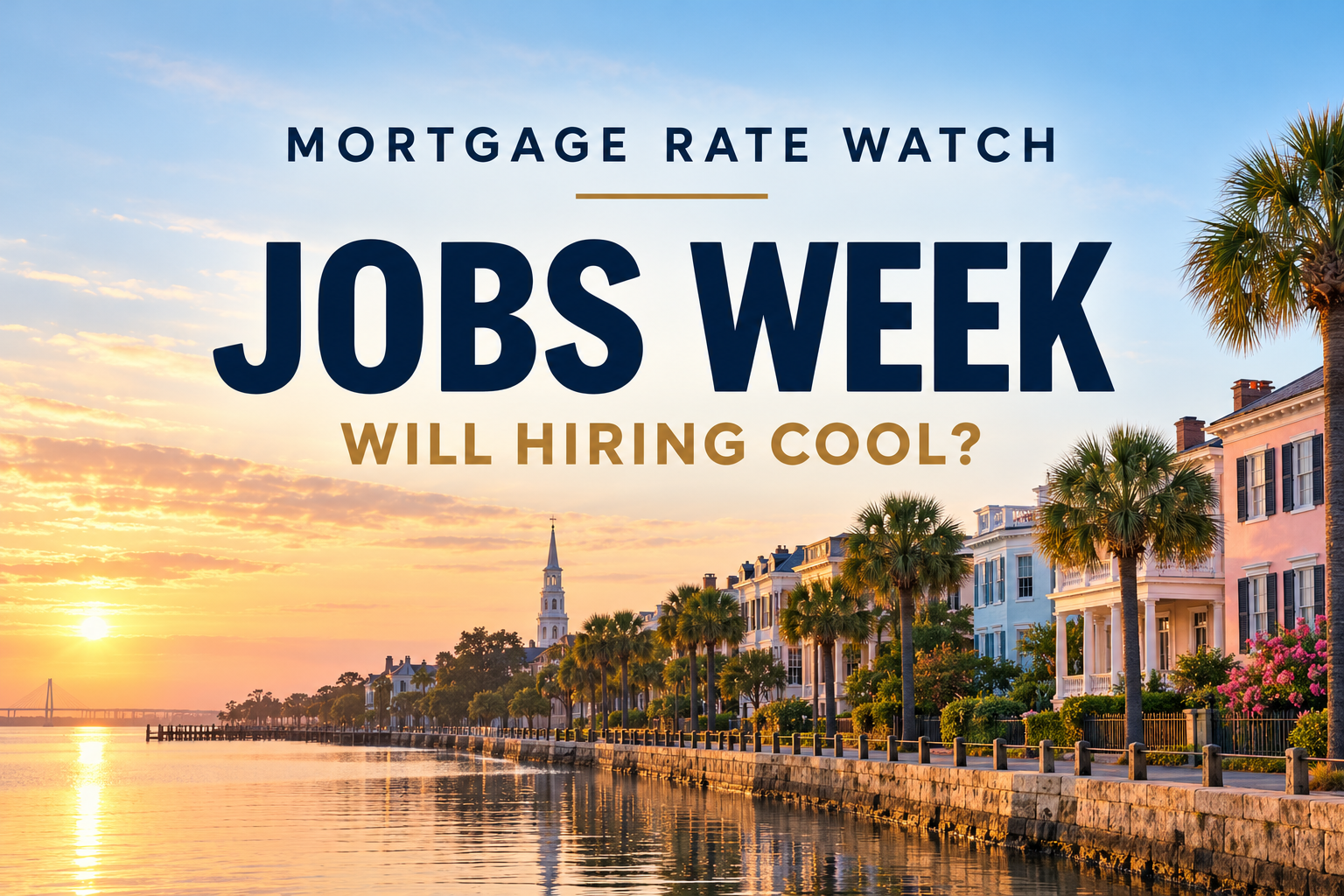
Charleston Lowcountry waterfront at sunrise with Mortgage Rate Watch and Fed Decision Week headline

Fed Decision Week: What GDP and Inflation Could Mean for Mortgage Rates

The Federal Reserve takes center stage this week, but Wednesday’s interest-rate decision is only part of the story. Thursday brings the first estimate of third-quarter economic growth, consumer spending and the Fed’s preferred inflation measurement—all at the same time.

The Quick Take

The Fed is widely expected to leave its benchmark rate unchanged Wednesday. Because that decision is already anticipated, mortgage rates may react more to what Fed Chair Kevin Warsh says about December—and to Thursday’s GDP and PCE inflation reports.

Review Your Mortgage Options

Where Mortgage Rates Stand

Freddie Mac’s latest weekly survey put the average 30-year fixed mortgage rate at 7.32% as of October 22, down from 7.40% the previous week. The average 15-year rate declined from 6.71% to 6.68%.

These are national survey averages rather than individual rate quotes. The actual rate available to a borrower depends on credit, down payment, property type, loan program, points and several other factors.

The 10-year Treasury yield was near 4.99% Monday morning. Mortgage rates do not follow the 10-year Treasury perfectly, but the two generally move in the same direction. The modest decline in yields offers some relief, although borrowing costs remain elevated.

Why an Expected Fed Pause Can Still Move Mortgage Rates

The Federal Reserve raised its benchmark rate in September to a target range of 3.75%–4.00%. Markets now overwhelmingly expect policymakers to leave that range unchanged at this week’s meeting.

That does not mean mortgage rates will simply sit still Wednesday.

The Federal Reserve does not directly set fixed mortgage rates. Mortgage pricing responds to Treasury yields and mortgage-backed securities, which reflect investors’ expectations for future inflation, economic growth and Fed policy.

Since a Fed pause is already expected, markets will focus on the language surrounding the decision and Chair Kevin Warsh’s press conference. A patient message could help stabilize longer-term rates. A stronger warning about inflation or another possible increase in December could push Treasury yields and mortgage rates higher.

Monday, October 26: A Quiet Beginning

No major rate-sensitive economic reports are scheduled Monday.

What it means for mortgage rates: A quiet calendar does not guarantee quiet rates. Bond markets can still react to geopolitical developments, energy prices and investors adjusting positions before Wednesday’s Fed announcement.

Tuesday, October 27: Business Spending, Housing and Consumers

  • September Durable Goods Orders at 8:30 a.m. Eastern
  • August Case-Shiller Home Price Index at 9 a.m. Eastern
  • September New Home Sales at 10 a.m. Eastern
  • October Consumer Confidence at 10 a.m. Eastern
  • Federal Reserve meeting begins

Current forecasts call for Durable Goods Orders to rise approximately 1.2% after being unchanged in August. New Home Sales are expected to ease from an annualized pace of 684,000 to approximately 655,000. Consumer Confidence is expected to edge down from 81.9 to around 81.2.

Those figures are forecasts and may change before the reports are released.

What it means for mortgage rates: Strong business spending, home sales and consumer confidence would suggest the economy remains resilient despite higher borrowing costs. That can place upward pressure on Treasury yields. Weaker results would be more supportive of the economic-cooling argument.

Wednesday, October 28: The Federal Reserve Decision

  • Federal Reserve policy statement at 2 p.m. Eastern
  • Fed Chair Kevin Warsh’s press conference at 2:30 p.m. Eastern

The Fed is widely expected to maintain its target rate at 3.75%–4.00%. Investors will therefore pay close attention to how policymakers describe inflation, employment and the possibility of another increase in December.

What it means for mortgage rates: A rate hold does not automatically mean mortgage rates will improve. If the Fed sounds more concerned about inflation or hints that another increase is likely, mortgage rates could move higher. A patient message would be more favorable for the bond market.

Thursday, October 29: GDP and the Fed’s Preferred Inflation Report

  • Advance estimate of third-quarter GDP at 8:30 a.m. Eastern
  • Personal Income and Consumer Spending at 8:30 a.m. Eastern
  • PCE and Core PCE Inflation at 8:30 a.m. Eastern
  • Initial Jobless Claims at 8:30 a.m. Eastern

Current consensus forecasts call for third-quarter economic growth near a 3.2% annualized pace, compared with 2.2% during the second quarter.

Consumer spending is expected to increase approximately 0.6%, while personal income is expected to rise approximately 0.3%.

Headline PCE inflation is expected to increase approximately 0.5% for the month and roughly 3.7% over the past year. Core PCE, which removes volatile food and energy prices, is expected to rise approximately 0.3% for the month and 3.1% annually.

What it means for mortgage rates: Strong growth combined with hotter inflation could increase expectations for another Fed rate increase and place upward pressure on mortgage rates. Softer inflation, slower consumer spending or weaker economic growth would generally be better received by the bond market.

Friday, October 30: The Cost of Employment

  • Third-quarter Employment Cost Index at 8:30 a.m. Eastern
  • Chicago Business Barometer at 9:45 a.m. Eastern

The Employment Cost Index is expected to rise approximately 0.8% for the quarter after increasing 0.9% previously.

What it means for mortgage rates: Wages and employee benefits make up a significant portion of business expenses. Stronger labor-cost growth can contribute to persistent inflation, while slower growth could give the Fed more room to remain patient.

Jared’s Take

This week is a good reminder that the Fed’s decision and mortgage rates are not the same thing.

A Fed pause is expected, but mortgage rates may still move quickly if the Fed’s message changes expectations for December. Thursday’s combination of GDP, consumer spending and PCE inflation could then either confirm that message or send the market in a different direction.

If you are buying, refinancing or deciding whether to lock a rate, the best strategy is not to gamble on one report. It is to understand your payment, compare the available options and decide how much market risk fits your situation.

Start Your Mortgage Review

Have questions about what this week’s news could mean for your plans? Reach out anytime. I’m happy to help you look at the numbers without the pressure or hype.

Oct. 30, 2026

Lowcountry Real Estate Report: October 23–30, 2026

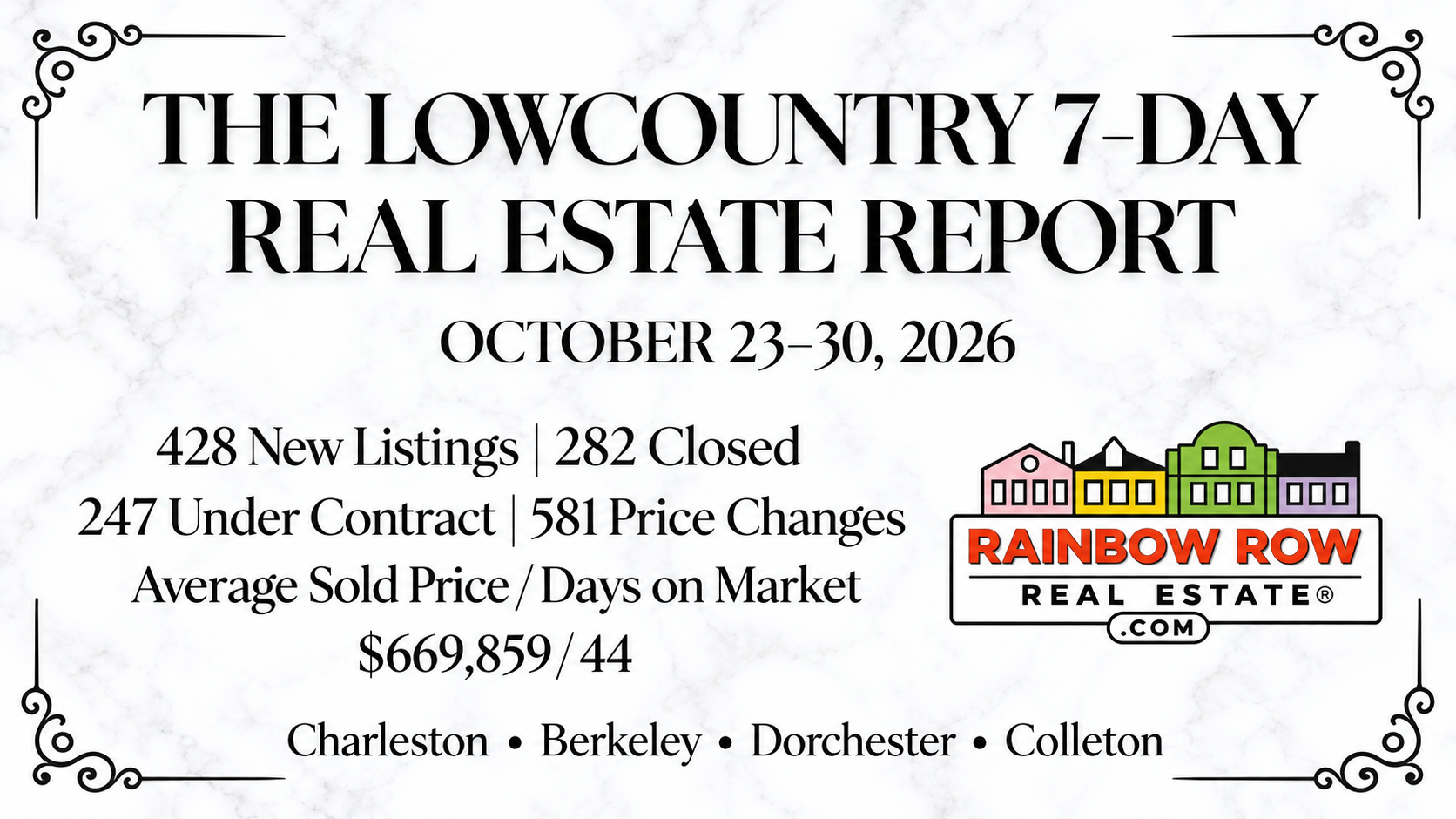
- Rainbow Row Real Estate Lowcountry market report for October 23–30, 2026, covering Charleston, Berkeley, Dorchester and Colleton counties.

Lowcountry Real Estate Report | October 23–30, 2026

Closings accelerated across the Lowcountry this week. From Charleston and Johns Island to Summerville, Ridgeville and Walterboro, 428 homes came on the market, 247 went under contract and 282 made it to the closing table.

The Quick Take

Closings rose sharply, contracts held steady and sold homes moved six days faster on average. Buyers are still active, but 581 price changes show that value and presentation continue to matter.

This Week’s Lowcountry Numbers

  • 428 new listings — down 18 from last week
  • 282 homes closed — up 65
  • 247 homes went under contract — unchanged
  • 581 price changes — down 43
  • $669,859 average sold price — down $87,166
  • 44 average days on market — down 6 days

Our Take

This was a stronger closing week. The 282 completed sales represented an increase of nearly 30% from the previous report, while 247 new contracts showed that buyers maintained the same pace for a second consecutive week. Fewer new listings arrived, so completed sales outnumbered new contracts and moved closer to the number of homes entering the market.

The average sold price moved from $757,025 to $669,859. That does not mean the value of a typical Lowcountry home fell by $87,166 in one week. Weekly averages can change substantially depending on which properties close. This week’s closing activity leaned heavily toward the Summerville and Ladson areas, while a different number of luxury closings can also move the regional average quickly.

Average days on market improved from 50 days to 44. That figure only covers homes that sold, but it is still encouraging: this week’s successful listings reached the closing table after spending about six fewer days on the market on average.

Where Were the Most Closings?

  1. Summerville/Ladson, Berkeley County — 52 closings
  2. Summerville/Ridgeville — 36 closings
  3. Johns Island — 20 closings

County-by-County Breakdown

Charleston County

174 new listings
117 homes closed
102 went under contract
211 price changes

Berkeley County

158 new listings
92 homes closed
84 went under contract
212 price changes

Dorchester County

86 new listings
64 homes closed
53 went under contract
145 price changes

Colleton County

10 new listings
9 homes closed
8 went under contract
13 price changes

What This Means for Buyers and Sellers

For buyers: Buyers are still successfully putting homes under contract, but the decline in new listings means the best choices may not sit around. Being prepared does not require rushing—it means knowing your budget, having financing ready and recognizing when the right home is priced fairly.

For sellers: The stronger closing total and shorter average marketing time are encouraging, but 581 price changes remain a reminder that buyers are comparing value carefully. A home that enters the market aligned with current competition has a better chance of becoming one of next month’s closings.

Source: Charleston Regional MLS/FlexMLS. Residential properties for sale only; rentals excluded. Data covers October 23–30, 2026, through 9:00 a.m. Eastern. Week-over-week figures compare with the previously published seven-day report. Statistics are market snapshots and are not an appraisal or a prediction of future value.

Posted in Market Updates
Oct. 26, 2026

Fed Decision Week: What GDP and Inflation Could Mean for Mortgage Rates

Charleston Lowcountry waterfront at sunrise with Mortgage Rate Watch and Fed Decision Week headline

The Federal Reserve takes center stage this week, but Wednesday’s interest-rate decision is only part of the story. Thursday brings the first estimate of third-quarter economic growth, consumer spending and the Fed’s preferred inflation measurement—all at the same time.

The Quick Take

The Fed is widely expected to leave its benchmark rate unchanged Wednesday. Because that decision is already anticipated, mortgage rates may react more to what Fed Chair Kevin Warsh says about December—and to Thursday’s GDP and PCE inflation reports.

Review Your Mortgage Options

Where Mortgage Rates Stand

Freddie Mac’s latest weekly survey put the average 30-year fixed mortgage rate at 7.32% as of October 22, down from 7.40% the previous week. The average 15-year rate declined from 6.71% to 6.68%.

These are national survey averages rather than individual rate quotes. The actual rate available to a borrower depends on credit, down payment, property type, loan program, points and several other factors.

The 10-year Treasury yield was near 4.99% Monday morning. Mortgage rates do not follow the 10-year Treasury perfectly, but the two generally move in the same direction. The modest decline in yields offers some relief, although borrowing costs remain elevated.

Why an Expected Fed Pause Can Still Move Mortgage Rates

The Federal Reserve raised its benchmark rate in September to a target range of 3.75%–4.00%. Markets now overwhelmingly expect policymakers to leave that range unchanged at this week’s meeting.

That does not mean mortgage rates will simply sit still Wednesday.

The Federal Reserve does not directly set fixed mortgage rates. Mortgage pricing responds to Treasury yields and mortgage-backed securities, which reflect investors’ expectations for future inflation, economic growth and Fed policy.

Since a Fed pause is already expected, markets will focus on the language surrounding the decision and Chair Kevin Warsh’s press conference. A patient message could help stabilize longer-term rates. A stronger warning about inflation or another possible increase in December could push Treasury yields and mortgage rates higher.

Monday, October 26: A Quiet Beginning

No major rate-sensitive economic reports are scheduled Monday.

What it means for mortgage rates: A quiet calendar does not guarantee quiet rates. Bond markets can still react to geopolitical developments, energy prices and investors adjusting positions before Wednesday’s Fed announcement.

Tuesday, October 27: Business Spending, Housing and Consumers

  • September Durable Goods Orders at 8:30 a.m. Eastern
  • August Case-Shiller Home Price Index at 9 a.m. Eastern
  • September New Home Sales at 10 a.m. Eastern
  • October Consumer Confidence at 10 a.m. Eastern
  • Federal Reserve meeting begins

Current forecasts call for Durable Goods Orders to rise approximately 1.2% after being unchanged in August. New Home Sales are expected to ease from an annualized pace of 684,000 to approximately 655,000. Consumer Confidence is expected to edge down from 81.9 to around 81.2.

Those figures are forecasts and may change before the reports are released.

What it means for mortgage rates: Strong business spending, home sales and consumer confidence would suggest the economy remains resilient despite higher borrowing costs. That can place upward pressure on Treasury yields. Weaker results would be more supportive of the economic-cooling argument.

Wednesday, October 28: The Federal Reserve Decision

  • Federal Reserve policy statement at 2 p.m. Eastern
  • Fed Chair Kevin Warsh’s press conference at 2:30 p.m. Eastern

The Fed is widely expected to maintain its target rate at 3.75%–4.00%. Investors will therefore pay close attention to how policymakers describe inflation, employment and the possibility of another increase in December.

What it means for mortgage rates: A rate hold does not automatically mean mortgage rates will improve. If the Fed sounds more concerned about inflation or hints that another increase is likely, mortgage rates could move higher. A patient message would be more favorable for the bond market.

Thursday, October 29: GDP and the Fed’s Preferred Inflation Report

  • Advance estimate of third-quarter GDP at 8:30 a.m. Eastern
  • Personal Income and Consumer Spending at 8:30 a.m. Eastern
  • PCE and Core PCE Inflation at 8:30 a.m. Eastern
  • Initial Jobless Claims at 8:30 a.m. Eastern

Current consensus forecasts call for third-quarter economic growth near a 3.2% annualized pace, compared with 2.2% during the second quarter.

Consumer spending is expected to increase approximately 0.6%, while personal income is expected to rise approximately 0.3%.

Headline PCE inflation is expected to increase approximately 0.5% for the month and roughly 3.7% over the past year. Core PCE, which removes volatile food and energy prices, is expected to rise approximately 0.3% for the month and 3.1% annually.

What it means for mortgage rates: Strong growth combined with hotter inflation could increase expectations for another Fed rate increase and place upward pressure on mortgage rates. Softer inflation, slower consumer spending or weaker economic growth would generally be better received by the bond market.

Friday, October 30: The Cost of Employment

  • Third-quarter Employment Cost Index at 8:30 a.m. Eastern
  • Chicago Business Barometer at 9:45 a.m. Eastern

The Employment Cost Index is expected to rise approximately 0.8% for the quarter after increasing 0.9% previously.

What it means for mortgage rates: Wages and employee benefits make up a significant portion of business expenses. Stronger labor-cost growth can contribute to persistent inflation, while slower growth could give the Fed more room to remain patient.

Jared’s Take

This week is a good reminder that the Fed’s decision and mortgage rates are not the same thing.

A Fed pause is expected, but mortgage rates may still move quickly if the Fed’s message changes expectations for December. Thursday’s combination of GDP, consumer spending and PCE inflation could then either confirm that message or send the market in a different direction.

If you are buying, refinancing or deciding whether to lock a rate, the best strategy is not to gamble on one report. It is to understand your payment, compare the available options and decide how much market risk fits your situation.

Start Your Mortgage Review

Have questions about what this week’s news could mean for your plans? Reach out anytime. I’m happy to help you look at the numbers without the pressure or hype.

Oct. 23, 2026

Saturdays in the South: Our College Football Stadium Bucket List

Southern college football stadium illustration at sunset with the headline “Saturdays in the South: Our College Football Stadium Bucket List.”

Quick Take: Ten Southern college football stadiums, unforgettable traditions, and a few tips for making a weekend of it. This is our personal travel bucket list, not a ranking of the best teams. And yes, Clemson gets the first spot.

Jump to the stadium bucket list ↓ | Which stadium would you add?

Staying close to home this weekend? Take a look at what’s new around the Lowcountry.

Browse the Newest Lowcountry Homes

Fall Saturdays in the South are just different.

The smell of barbecue in the parking lots. Marching bands echoing across campus. Thousands of fans dressed in school colors. Traditions passed down through generations.

College football gives us an excuse to load up the car, spend time with family and friends, and experience a town at its most spirited.

This isn’t a ranking of the best football teams. It’s our bucket list of college football stadiums that every fan should experience at least once. Some are famous for their entrances. Others belong here for the tailgates, the setting, or the atmosphere after dark.

If you’re planning a football road trip through the Southeast, these are the stops we’d start with.

1. Clemson – Memorial Stadium (Death Valley)

Clemson, South Carolina

You knew where this list was going to start.

Clemson’s run down The Hill, with players touching Howard’s Rock before entering the stadium, is the entrance famously described as “the most exciting 25 seconds in college football.” Watching that tradition unfold in a sea of orange belongs on our list all by itself.

Our Tip: If the schedule and your budget line up, aim for a Saturday night matchup against a ranked opponent. Give yourself plenty of time to get inside before the entrance.

2. Alabama – Saban Field at Bryant-Denny Stadium

Tuscaloosa, Alabama

Championship history, a stadium that seats more than 100,000, and the Walk of Champions. Tuscaloosa offers the kind of game-day setting that makes you understand just how much college football means in the South.

Our Tip: Arrive early and spend some time around The Quad before heading toward the stadium. The day deserves more than a last-minute dash to your seat.

3. Florida – Ben Hill Griffin Stadium (“The Swamp”)

Gainesville, Florida

Loud, humid, and full of energy. The Swamp has the kind of atmosphere that makes a game feel bigger than what’s happening between the sidelines.

Our Tip: Wear comfortable shoes and plan for the weather. You’ll likely do more walking than you expect, and a fall date on the calendar doesn’t guarantee cool temperatures in Gainesville.

4. LSU – Tiger Stadium

Baton Rouge, Louisiana

Saturday night in Death Valley—the other one—belongs on every Southern football travel list. The crowd, the anticipation, and Louisiana’s tailgating culture make this a whole-day experience.

Our Tip: Show up hungry. Leave time to explore the food scene and soak up the atmosphere before kickoff.

5. Georgia – Sanford Stadium

Athens, Georgia

A beautiful campus, a historic stadium, and a downtown that makes it easy to turn a football game into a weekend away. A game between the hedges is a natural addition to this list.

Our Tip: Build in a few hours for downtown Athens. If you’re hoping to eat at a particular restaurant, make a plan before game-day crowds arrive.

6. Auburn – Jordan-Hare Stadium

Auburn, Alabama

The pregame eagle flight is one of those traditions you want to see in person. Add the energy inside Jordan-Hare and the possibility of a celebration at Toomer’s Corner, and Auburn earns its place.

Our Tip: Get to your seat early enough for the eagle flight. If Auburn wins, head toward Toomer’s Corner afterward to experience another beloved tradition.

7. South Carolina – Williams-Brice Stadium

Columbia, South Carolina

“2001.” Sandstorm. The Gamecock Walk.

Even with our Clemson loyalties, we can appreciate what makes a packed Williams-Brice special. When the music hits and the crowd gets going, it’s a South Carolina football experience worth having.

Our Tip: Be in your seat before kickoff. The entrance is a big part of the experience, so don’t spend it standing in a concession line.

8. Tennessee – Neyland Stadium

Knoxville, Tennessee

A massive stadium beside the Tennessee River and a tailgating tradition that takes to the water. The Vol Navy makes Knoxville a particularly appealing stop for anyone who loves both football and boating.

Our Tip: Leave time to explore the riverfront and see the boats gathered for game day. Make it part of your visit instead of rushing straight to the stadium.

9. East Carolina – Dowdy-Ficklen Stadium

Greenville, North Carolina

This is one of the stops we’d include for fans who want to look beyond the biggest stadiums. Pirate Nation brings plenty of loyalty and energy, and Greenville deserves a place on the road-trip map.

Our Tip: Don’t choose solely by stadium size. Look for a meaningful matchup and give yourself time to enjoy the atmosphere around campus.

10. NC State – Carter-Finley Stadium

Raleigh, North Carolina

Passionate fans, plenty of tailgating, and the appeal of a big game under the lights. Carter-Finley rounds out our first ten, with Raleigh offering plenty to explore over the rest of the weekend.

Our Tip: Arrive early and enjoy the tailgate scene. Be a respectful visitor, start a conversation, and let the day be about more than the final score.

Before You Hit the Road

Check the host school’s official game-day information before traveling. Kickoff times, parking arrangements, bag policies, and entry rules can affect your plans. For a big matchup, it also helps to sort out lodging early.

Which Stadium Belongs on Part 2?

We know we left some great ones off this list: Ole Miss, Florida State, Virginia Tech, Texas A&M, Arkansas, Kentucky, and App State, just to name a few.

But that’s the fun of a bucket list. There’s always another trip to plan.

Which stadium have you visited? Which is your favorite? And which one absolutely belongs on Part 2? Send us your pick through our website chat. If you came here from our email, hit reply there—we’d love to hear your game-day stories.

College football is about road trips, traditions, tailgates, and memories you’ll talk about for years. If this list inspires your next trip, let us know where you end up.

Jared & Erin Jackson
Rainbow Row Real Estate

Keep Exploring the Lowcountry

Whether your ideal Saturday starts at a stadium, on the water, or on your own back porch, there’s plenty to love about life here.

Read more local stories and guides, or explore the newest homes across the communities we serve.

Find Your Next Home Base

Posted in Lowcountry Living
Oct. 23, 2026

Lowcountry Real Estate Report: October 16–23, 2026

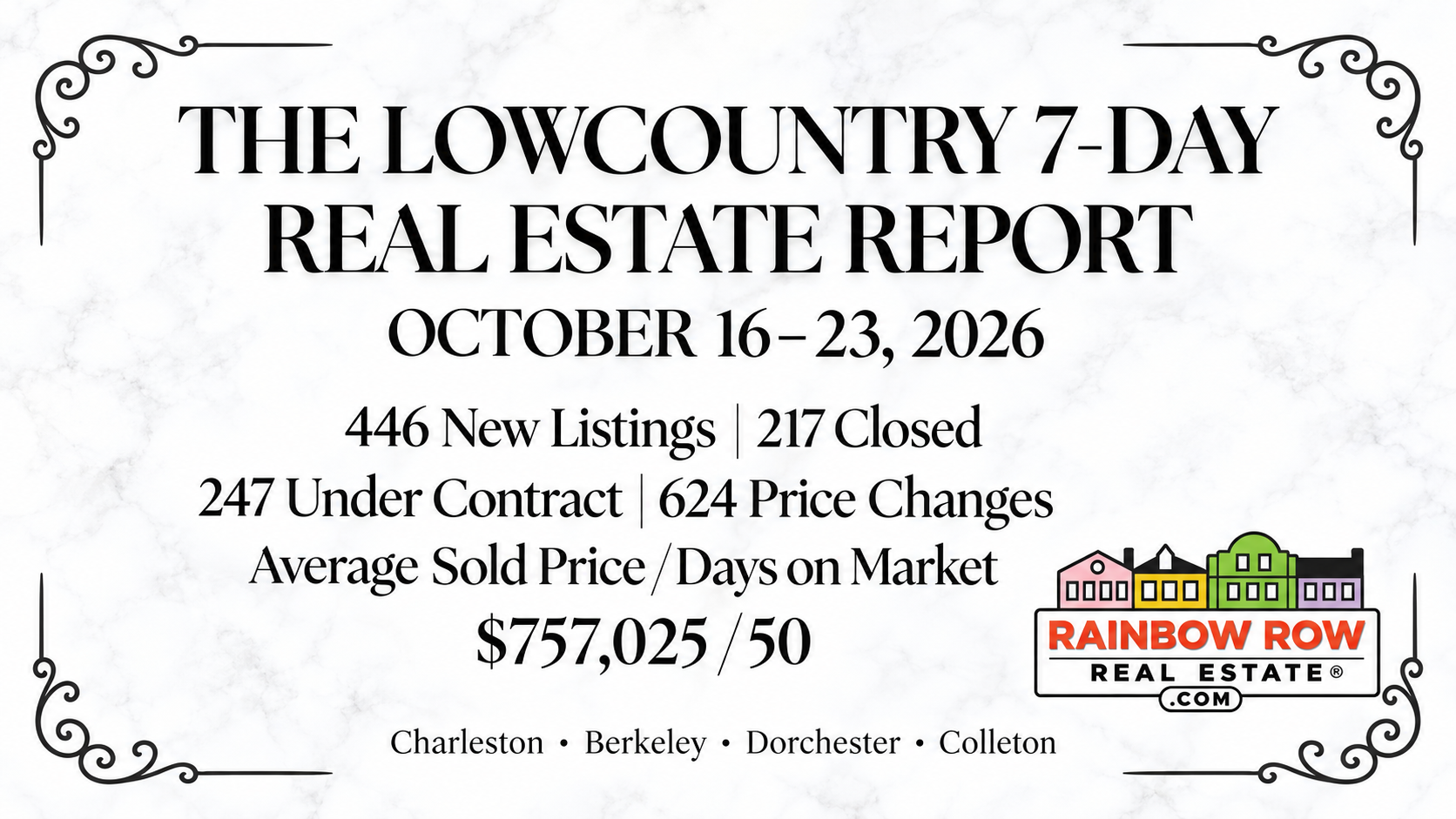
Lowcountry 7-day real estate report for October 16–23, 2026, showing 446 new listings, 217 closings, 247 contracts, 624 price changes, a $757,025 average sold price and 50 average days on market.

Lowcountry Real Estate Report | October 16–23, 2026

Real estate activity eased slightly across the Lowcountry this week. From Charleston and Mount Pleasant to Summerville, Ridgeville and Walterboro, 446 homes came on the market, 247 went under contract and 217 made it to the closing table.

Jump to The Quick Take

The Quick Take

The market slowed modestly this week, but it did not stop. Buyers put 247 homes under contract, while 624 price changes show that sellers are still watching the market and making adjustments when needed.

Explore Lowcountry Homes

This Week’s Lowcountry Numbers

  • 446 new listings — down 23 from last week
  • 217 homes closed — down 17
  • 247 homes went under contract — down 25
  • 624 price changes — down 6
  • $757,025 average sold price — down $108,969
  • 50 average days on market — down 1 day

Our Take

All four major activity counts moved lower this week, but the changes were fairly modest. The biggest practical takeaway is that buyers are still active: 247 homes went under contract during the seven-day period. At the same time, 624 price changes show that sellers continue to respond to buyer feedback, competing listings and current affordability.

The average sold price dropped from $865,994 last week to $757,025 this week. That does not mean Lowcountry home values fell by roughly 12% in seven days. A weekly average can move sharply depending on the mix of properties that happened to close, especially when a handful of luxury sales enter or leave the calculation. Longer-term trends and neighborhood-level comparisons provide much better context for an individual property.

Average days on market improved slightly, moving from 51 days to 50. In plain English: homes are still taking around seven weeks to sell on average, but correctly priced homes can move much faster.

Where Were the Most Closings?

  1. Summerville/Ridgeville — 35 closings
  2. Summerville/Ladson, Berkeley County — 19 closings
  3. Mount Pleasant south of the IOP Connector — 15 closings

County-by-County Breakdown

Charleston County

206 new listings
100 homes closed
119 went under contract
239 price changes

Berkeley County

129 new listings
59 homes closed
77 went under contract
216 price changes

Dorchester County

100 new listings
53 homes closed
45 went under contract
156 price changes

Colleton County

11 new listings
5 homes closed
6 went under contract
13 price changes

What This Means for Buyers and Sellers

For buyers: New choices are still arriving, and frequent price adjustments may create room for a better conversation on price, closing costs or repairs. That does not mean every seller is ready to negotiate, but preparation matters when the right home appears.

For sellers: Buyers are active, but they are paying attention to value. The first few weeks on the market matter. Pricing from current neighborhood competition—not an old peak or an online estimate—can help a home attract serious attention before it becomes another price change.

Start Your Lowcountry Home Search

Source: Charleston Regional MLS/FlexMLS. Residential properties for sale only; rentals excluded. Data covers October 16–23, 2026, through 8:00 a.m. Eastern. Week-over-week figures compare with the previously published seven-day report. Statistics are market snapshots and are not an appraisal or a prediction of future value.

Posted in Market Updates
Oct. 21, 2026

What Credit Score Do You Need to Buy a Home?

What credit score do you need to buy a home? Mortgage guidance from Jared W. Jackson, South Carolina Lender.

What Credit Score Do You Need to Buy a Home?

“My credit probably isn’t good enough.”

That assumption can keep someone from starting a homebuying conversation for months—or years.

Your credit matters. But there isn’t one score that determines everyone’s mortgage options.

Different loan programs have different rules. Lenders can add their own requirements. And your income, monthly debts, savings, and credit history also help determine what may be available.

Before counting yourself out, let’s look at the full picture.

Program rules and lender requirements aren’t always the same

A mortgage program may permit something that a particular lender doesn’t offer.

Those additional lender requirements are often called “overlays.” They can include higher credit score requirements or restrictions on certain credit situations.

That’s why a minimum score you see online may reflect one lender’s policy rather than a rule that applies everywhere.

Here’s how the major programs differ.

FHA: credit score and down payment work together

FHA’s baseline guidelines generally allow:

  • 580 or higher: down payments as low as 3.5%.

  • 500–579: a minimum 10% down payment.

Those figures don’t guarantee approval or mean every FHA lender offers financing at those scores.

The lender still reviews your income, debts, credit history, assets, and property. Recent late payments or other credit issues can matter even when your score meets the stated minimum.

VA: no VA-set minimum credit score

VA does not establish a minimum credit score for its home loan program.

Individual lenders, however, can set their own credit requirements.

Eligible veterans, service members, and certain surviving spouses still need to meet the applicable eligibility and underwriting requirements. Having no VA-set score minimum does not mean credit history is ignored.

If you’ve heard that every VA borrower needs a 620, that isn’t a universal VA rule.

USDA: 640 isn’t a universal program minimum

USDA’s guaranteed loan program does not establish a universal minimum credit score.

A lender may use a score requirement such as 640, but that number alone doesn’t tell you whether every USDA option is available or unavailable.

Credit history, repayment ability, underwriting results, and lender requirements all matter. Household income limits and property eligibility also apply.

A lower score needs an individual review—not an automatic promise of approval or an automatic dismissal.

Conventional: the underwriting method matters

You’ll still see 620 described as the minimum conventional mortgage score. That doesn’t capture every current scenario.

Fannie Mae’s Desktop Underwriter, its automated underwriting system, no longer applies a minimum credit score floor. It evaluates the overall application and credit risk.

That doesn’t mean credit scores are irrelevant or that any score will qualify. Lenders may maintain their own minimums, and manually underwritten loans and other conventional programs have different requirements.

The useful question is: “Which programs and lenders fit my complete application?”

Why your app score may be different

The score shown by your credit card company or credit monitoring app may differ from the score used during a mortgage review.

Different scoring models, credit bureaus, and reporting dates can produce different numbers.

Use those tools to monitor trends and watch for problems. But don’t treat one app score as a mortgage approval—or a denial.

What else does a lender review?

Your score is one piece of a larger review that may include:

  • Your payment history and any recent late payments.

  • Monthly debt payments compared with qualifying income.

  • Employment and income documentation.

  • Savings, down payment funds, and reserves.

  • Collections, charge-offs, bankruptcies, or foreclosures.

  • The property and the loan program’s requirements.

Two buyers with similar scores can have different financing options because the rest of their applications look different.

What should you do before applying?

Keep payments current, review your credit reports for errors, and avoid taking on unnecessary new debt.

Before closing accounts, opening new credit, or using a large portion of your savings to pay off old accounts, talk through the plan with your lender. The best next step depends on what’s actually affecting your application.

You don’t need to guess your way through it.

Jared’s Take

A credit score is information we use to make a plan. It isn’t a judgment about you.

Sometimes the review shows a path to buying now. Sometimes it shows that paying down a balance, correcting an error, or allowing more time would put you in a better position.

Either way, you leave with more useful information than “I probably can’t.”

If you’re thinking about buying in Charleston, North Charleston, Summerville, or elsewhere along the South Carolina coast, let’s review your situation and figure out a practical next step.

You don’t need perfect credit to start a conversation.

Jared W. Jackson
Rainbow Row Real Estate | South Carolina Lender
Mortgage Loan Originator, NMLS 2763373
Ascend Financial Group, Company NMLS 1629704

Program guidelines do not guarantee lender availability or approval. All loans are subject to credit, income, asset, property, and underwriting approval. This is not a commitment to lend.

Oct. 21, 2026

Do You Really Need 20% Down to Buy a Home?

Do you really need 20% down? Low and no down payment mortgage options with Jared W. Jackson, South Carolina Lender.

Do You Really Need 20% Down to Buy a Home?

If you’ve been putting off buying a home because you haven’t saved a 20% down payment, let’s talk.

Twenty percent can be a great option. But it isn’t the minimum required for every mortgage.

Depending on your qualifications, the property, and the loan program, you may have options with a much smaller down payment. Some eligible buyers can purchase without a down payment at all.

The first step is finding out which options actually fit your situation.

Where does the 20% number come from?

On a conventional mortgage, putting 20% down generally allows you to avoid private mortgage insurance, commonly called PMI.

That’s a benefit worth considering. But avoiding PMI and qualifying to buy a home are two different things.

A larger down payment also means borrowing less. A smaller down payment can leave more savings available for moving, repairs, and emergencies.

The right choice depends on both your monthly budget and the money you’ll have left after closing.

What are the common down payment options?

Loan program Down payment starting point What to know
Select conventional programs As low as 3% Eligibility requirements apply; PMI is generally required below 20% down.
FHA As low as 3.5% Credit and lender requirements apply; FHA mortgage insurance is required.
VA 0% for eligible borrowers Entitlement, appraisal, and lender requirements apply.
USDA guaranteed 0% for eligible borrowers and properties Household income limits and property eligibility requirements apply.

These are starting points, not approval guarantees. Your circumstances may require a different down payment.

Conventional: you may have options below 20%

Certain conventional programs allow qualified buyers to put as little as 3% down.

These programs have specific requirements. Depending on the option, those can include income limits, first-time buyer requirements, or homebuyer education.

PMI generally applies when putting less than 20% down. That adds a cost, but it’s worth comparing the full payment and cash needed before ruling out the option.

FHA: as little as 3.5% down

FHA financing offers down payments as low as 3.5% for qualified borrowers.

Credit history and lender requirements matter, and not everyone qualifies for that minimum. FHA also has its own mortgage insurance costs.

A smaller down payment is one part of the comparison. We should also look at the interest rate, insurance, closing expenses, and total monthly payment.

VA: a benefit worth exploring

Eligible veterans, service members, and certain surviving spouses may qualify for a VA purchase loan without a down payment.

VA loans don’t require monthly mortgage insurance. A VA funding fee may apply unless the borrower qualifies for an exemption.

Entitlement and appraisal results matter, too. For example, an appraisal gap or limited remaining entitlement can mean a buyer needs additional cash.

If you have military eligibility, it’s worth reviewing your benefit before assuming another loan is your best option.

USDA: check the address before assuming

USDA guaranteed loans offer no down payment financing for eligible borrowers purchasing eligible primary residences.

Household income limits apply, and the property must fall within an eligible area. Don’t assume you need to buy a farm or move hours away—check the actual address.

USDA guaranteed loans also have upfront and annual guarantee fees, which belong in the cost comparison.

What does that mean in dollars?

For a hypothetical $350,000 purchase:

Down payment Amount
3% $10,500
3.5% $12,250
20% $70,000

Eligible VA or USDA buyers may have a $0 down payment requirement.

These figures show the down payment only. They do not include closing costs, prepaid expenses, or any required reserves. They are illustrations, not loan offers.

No down payment doesn’t mean no money needed

This is an important distinction.

Even with a no down payment loan, you may still need money for closing expenses, inspections, deposits, insurance, and other items.

Negotiated seller contributions may help cover eligible closing costs. Assistance programs may also be worth exploring, depending on your qualifications and availability.

Those options need to be reviewed before writing an offer so your contract and financing work together.

Jared’s Take

Don’t let an assumed $70,000 savings requirement make the decision for you.

And don’t let a low down payment convince you to buy before your budget is ready.

Let’s look at your income, credit, savings, debts, and a monthly payment you’re comfortable with. Then we can compare what buying now would look like against continuing to save.

Whether you’re looking in Charleston, North Charleston, Summerville, or elsewhere along the South Carolina coast, you deserve a plan built around your actual numbers.

You don’t need 20% saved to start the conversation.

Jared W. Jackson
Rainbow Row Real Estate | South Carolina Lender
Mortgage Loan Originator, NMLS 2763373
Ascend Financial Group, Company NMLS 1629704

Program availability and requirements vary. All loans are subject to credit, income, asset, property, and underwriting approval. This is not a commitment to lend.

Oct. 19, 2026

Can the Seller Help Pay Your Closing Costs?

Seller contributions can help with eligible closing expenses. Conventional limits vary by loan-to-value and occupancy; VA’s 4% rule applies to specific concessions, separately from ordinary closing costs.

Can the Seller Help Pay Your Closing Costs?

You’ve been saving for a down payment. You’ve looked at homes online. You might even have a monthly payment in mind.

Then someone mentions closing costs.

Yep. The down payment is only part of the picture.

But here’s something worth knowing before you write an offer: the seller may be able to help cover some of those expenses.

That’s called a seller contribution or seller credit, and when it’s structured correctly, it can reduce the amount of cash you need to bring to closing.

What can a seller contribution cover?

Depending on your loan program, a negotiated seller credit may help pay eligible expenses such as:

  • Loan origination and other lender fees.

  • Closing attorney and title charges.

  • Appraisal and recording fees.

  • Prepaid insurance, taxes, and initial escrow deposits.

  • Discount points or an approved interest rate buydown.

The seller agrees to apply part of their proceeds toward eligible buyer expenses. The credit is documented in the contract and accounted for at closing.

It isn’t an automatic benefit, and the seller doesn’t have to agree. It’s one of the terms you can negotiate.

Your down payment is still a separate piece

Seller credits toward closing costs generally cannot satisfy your required down payment.

They can, however, help you preserve the savings you would otherwise spend on eligible closing expenses.

That distinction matters. Having enough for the down payment doesn’t always mean you have enough for the entire purchase—and getting help with closing costs doesn’t automatically eliminate every upfront expense.

How much can the seller contribute?

The answer depends on the mortgage program, how the property will be used, and other loan details.

Conventional loans

For a primary residence or second home under standard Fannie Mae guidelines, financing contribution limits are:

Loan-to-value ratio* Maximum contribution
Above 90% 3%
75.01%–90% 6%
75% or less 9%
Investment property 2%

Applicable combined loan-to-value requirements also matter. Percentages are based on the lower of the purchase price or appraised value.

A quick graphic doesn’t capture every conventional scenario. Have your lender confirm the limit for your particular loan.

FHA loans

Interested parties may generally contribute up to 6% of the sales price toward eligible closing expenses, prepaid items, and other permitted costs.

USDA guaranteed loans

Seller and other interested-party contributions are generally limited to 6% of the sales price, subject to eligible uses.

VA loans

VA’s 4% rule is not an overall cap on seller-paid closing costs.

Certain concessions—such as paying the buyer’s VA funding fee or qualifying debt payoff—are limited to 4% of the property’s VA-established reasonable value. Ordinary buyer closing costs are treated separately.

That distinction can make a meaningful difference when structuring a veteran’s offer.

Jumbo loans

Jumbo contribution limits depend on the lender and specific program. Confirm the guidelines before negotiating a credit.

For every program, a maximum percentage is a ceiling—not a promise that you can use that entire amount.

What could this look like?

Here’s a simplified example:

You negotiate a $7,000 seller credit and have $9,000 in eligible closing expenses. If your loan permits the credit, that could leave you responsible for $2,000 of those expenses.

Your required down payment would remain separate.

This example assumes the credit fits the program’s rules and all listed expenses are eligible. Your actual cash to close would also reflect deposits, other credits, and the final closing figures.

Would a price reduction be better?

Sometimes. It depends on what you need.

A lower purchase price can reduce the amount you borrow. A seller credit can reduce the cash you need for eligible closing expenses.

If keeping savings available for moving, repairs, or an emergency fund is a priority, a credit may be worth comparing with a price reduction. We can look at both options before you decide what to request.

The home still needs to support the agreed price through the appraisal and underwriting process.

A few things to remember

The seller has to agree. Contributions are negotiated alongside the price and other contract terms.

You need eligible expenses to use the credit. An unused balance generally isn’t money you can pocket.

Some expenses may come due before closing. Plan for inspections, deposits, and other upfront costs even when you’re requesting seller assistance.

Talk to your lender before submitting the offer. A credit that sounds helpful can create problems if it exceeds your program’s limits or the expenses you can actually use it for.

Jared’s Take

Before deciding you need another year of saving, find out what your actual numbers look like.

That doesn’t mean every seller will pay your closing costs or every buyer can purchase with very little cash. It means your plan should be based on your financing options, estimated expenses, and the terms we may be able to negotiate.

Whether you’re buying in Charleston, North Charleston, Summerville, or elsewhere along the South Carolina coast, let’s start with a conversation about what works for you.

You don’t need to have every answer before reaching out. That’s what I’m here for.

Jared W. Jackson
Rainbow Row Real Estate | South Carolina Lender
Mortgage Loan Originator, NMLS 2763373
Ascend Financial Group, Company NMLS 1629704

Loan programs and contribution limits are subject to applicable guidelines and lender requirements. All loans are subject to credit, income, asset, property, and underwriting approval. This is not a commitment to lend.